Bots Are Already on the Beta
18 characters, nearly all level 5 Tauren hunters, standing together in a town that belongs to a zone for level fifties. This is the one development that would undo every price we have published, so we would rather write it up while it is still inconvenient than after everybody else has.
What was found
A player ran the in-game Who panel against Winterspring and got 18 results. Every entry visible in the list is a Tauren hunter at level 5 or 6, every one is in Everlook, and several carry names written in Chinese. Everlook is the goblin town in the middle of the zone; Winterspring itself is built for characters in their fifties, and there is no low-level content anywhere in it.
That combination is the whole story. One low-level character in a high-level zone is a curiosity — somebody was dragged there by a friend. 18 of the same race and class, in the same spot, is a fleet.
Why the fleet is Tauren. The race choice is not decoration. Tauren carry Plainsrunning, which raises movement speed on foot after a short wind-up, and on the beta it works across the open ground of the Barrens, Thousand Needles and Tanaris — exactly the long, flat routes a gathering character spends most of its time crossing. On top of that the race has 3% extra speed while mounted, which applies everywhere and compounds over a route that is repeated all day. For an operator running many characters at once, travel time is the main cost, and Tauren is the only race that cuts it twice.
The limit is worth stating plainly: Plainsrunning drops the moment the character enters combat, and it has to be built up again from a stop. That makes it useful for empty roads and close to useless anywhere with aggressive mobs on the path, which is part of why the reported routes sit in the zones named above rather than in contested ground. We do not know that this is why these particular accounts were made Tauren — the racial Cultivation is reason enough on its own — but anyone picking a race for a gathering route would land on the same answer.
The argument players themselves add. In the replies under the clip, Cultivation is not the only reason given for the race. The second one is money: Plainsrunning arrives with the character and costs nothing, so an operator who never intends to level these accounts also never has to buy a mount for any of them. On a single character that is a minor saving. Spread over a fleet that is created, used and abandoned, it is the difference between a per-character setup cost and no setup cost at all, which is the same logic that made level 5 the chosen bracket in the first place.
The slot complaint attached to the same race. A second thread running alongside the clip is about something that looks unrelated at first: players saying they cannot create the Horde characters they want, and tying that shortage to fleets like this one. The argument they make is simple enough to follow. If accounts are being opened purely to produce Tauren gatherers, the characters sit on the Horde side, in the same starting zone, and they are never deleted once a route stops paying. Whatever room exists for new Horde characters gets used up by rosters that nobody plays.
We cannot confirm any part of that chain, and it is worth being clear about which link is weak. Nobody has shown how many of these accounts exist, so the step from one Who search to a visible effect on who can roll what is an inference players are making, not a figure anyone has published. What we can say is that the race reasoning above points the same way: an operator choosing Tauren for travel speed and Cultivation is choosing Horde by necessity, not preference, and every fleet built that way lands on one faction.
Do not expect this to be a PvP realm problem. The assumption that PvE realms stay cleaner comes up every time a fleet is posted, and the people arguing against it in the same thread make a straightforward case: a route that pays on one realm type pays on the other, because the herbs and ore end up in 2 separate auction houses with 2 separate sets of buyers. Covering both is more supply sold, not more work. The difference they point to is not whether the farm exists but what happens at the node — on a PvP realm a gatherer standing still can be interrupted by any player who walks past, on a PvE realm it cannot. That changes how an operator picks routes and how long a character survives in one spot, and it does nothing to the question of whether the route is worth running at all.
Worth saying plainly that this is reasoning from the thread rather than anything measured. Nobody has posted a count of affected accounts broken down by realm type, and we have not tried to build one. If you are choosing a realm and treating raw material prices as part of that decision, the safer assumption is that both sides see the same pressure and the gap between them is smaller than it sounds.
The same thread also tries to put a number on the other side of the equation, with one reply valuing a single black lotus at roughly 40 g. We are passing that along as what it is — a forum reply, not a measurement. Nobody in that discussion showed an auction record, and we have not tried to confirm it. The reason it is worth repeating anyway is the shape of the claim rather than the figure: if a character that cost an account and nothing else can walk away with a herb that normally requires a levelled gatherer, then the usual floor under what gold is worth is not built on anything.
What players are asking for. The same discussions are fairly consistent about what they want done, and it is 2 separate things rather than one. The first is a staffed team whose only job is reviewing reports on these accounts, on the argument that a queue handled alongside everything else moves slower than a fleet can be rebuilt. The second is the part that actually touches prices: removing the listings those accounts have already put on the auction house, not just closing the accounts behind them. We have not seen any statement from Blizzard on either request, so treat both as player demands and nothing more.
The distinction matters for anyone reading the rest of this write-up as a price argument. Shutting a farm down stops new supply, but the herbs and ore already sitting in the auction window keep setting the undercut line until somebody buys them out. Pulling those listings is the only step that pushes the floor back up on the same day it is taken, which is why it keeps coming up in threads that otherwise disagree about how large the problem is. Whether any of it happens on the beta, or waits for launch, is not something we can tell you yet.
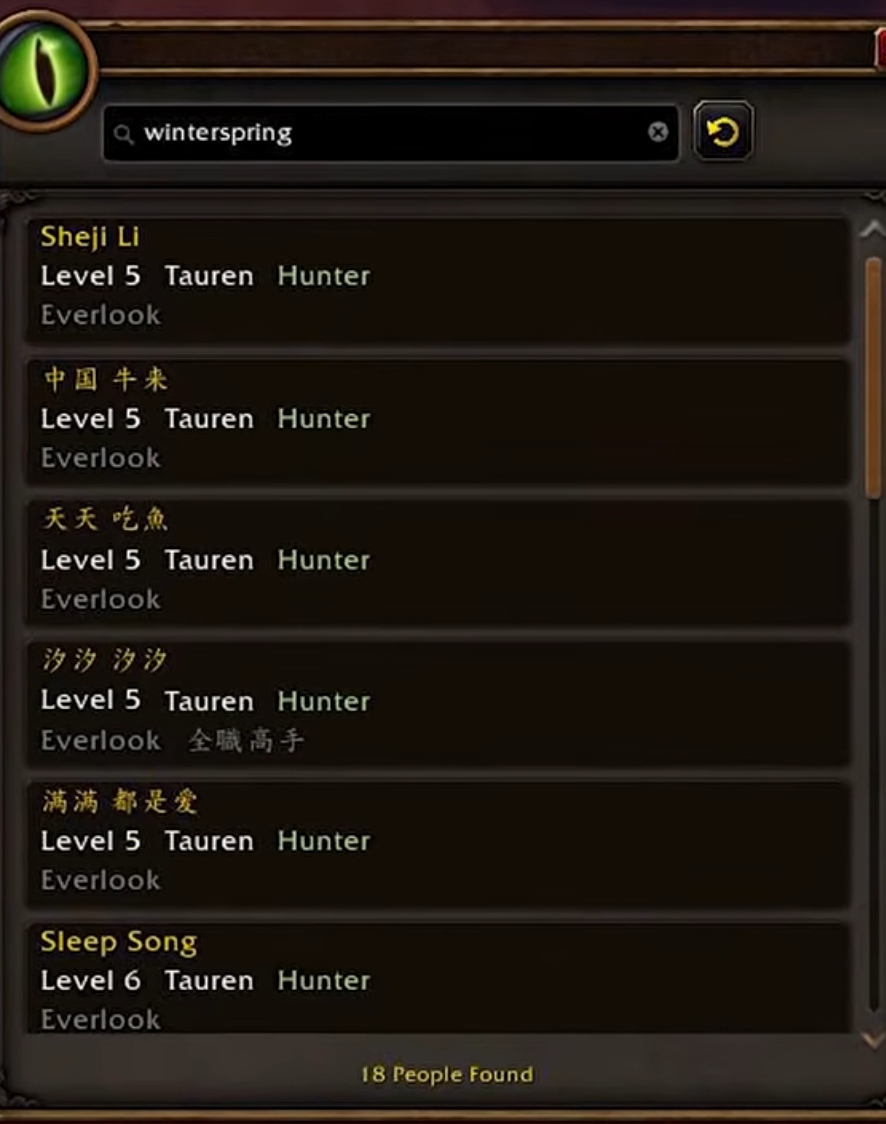
What is claimed beyond the screen
The player reporting it adds 2 things the screenshot cannot show. That the characters get there by moving through the air or below the terrain rather than by walking. And that they use a new racial ability — players are calling it sprouting — which produces a copy of a herb and allows it to be picked without the Herbalism skill at all.
If that second part is accurate it is the interesting half, because it removes the last reason a gathering bot needed a levelled character. Buy the cheapest account, make a Tauren, walk it out of the starting zone and harvest a region 40 levels above it.
Visible in the screenshot
- 18 results for a Who search on Winterspring
- All Tauren hunters, level 5 and 6
- All standing in Everlook
- Several names in Chinese
Nobody has established
- That the accounts are automated at all
- Who is running them
- Who is running them, and whether Blizzard is acting
- Whether Blizzard is aware or acting
- Any of it outside one video
The ability turned out to be real, and we can now say what it does
When we wrote the section above, whether the racial behaved as described was the open question. It is no longer open. The ability is in the game files under its own name, Cultivation, a Tauren racial added in patch 1.60.1, and the tooltip reads: grow a duplicate of a nearby herb that you can harvest without requiring the Herbalism skill, each herb only once.
That is the half that matters, and it is exactly as reported. The rest of the picture has to come from elsewhere, and it cuts both ways.
| What this allows | What limits it |
|---|---|
| A black lotus node needs Herbalism 300. The cultivated duplicate needs none, so a level 5 Tauren standing next to one can walk away with it. | One plant may only be cultivated once, so a group cannot queue up on the same node. |
| Winterspring holds 41 known black lotus spawn points, and the herb sits in only 4 zones in the whole world. | A player who tested the racial on the beta reports an hour between uses — the tooltip hides it, the button greys out and says so. |
Our reading: the hour is the reason this looks the way it does. At 1 plant an hour a single character is worth almost nothing, so anyone farming this way scales by opening more characters rather than by moving faster. 18 of them in one town is not the overkill it first appears — it is the arithmetic.
Still unestablished: that these particular accounts are automated, and that anyone is actually harvesting lotus this way at scale. The mechanics permit it. Permitting and doing are different claims, and we are only making the first one.
Update — the racial now has a level gate. Cultivation no longer works at any character level. The ability carries a requirement tied to the plant it copies: the gathering skill the herb needs, divided by 5. A herb that asks for 300 Herbalism therefore asks for a level 60 character, and that is the bracket black lotus sits in. We have not seen a patch note that names the change, so we cannot date it; what we can say is that the requirement is part of how the ability reads now.
The loot rule on mobs is the other half of this. Herbs are settled — one plant, one pick, and Cultivation copies it once. Kills are not. Under a single-tag rule the first character to engage owns the corpse and everyone else gets nothing, so a fleet of 18 accounts produces 18 separate kills worth of drops and pays 18 separate travel times to do it. Output moves in a straight line with headcount, which is the same arithmetic a solo farmer works with, and that is what keeps a floor under the price of what comes off those mobs.
A shared-tag rule changes the shape of it. If every character that lands damage gets its own loot roll, one pull feeds the whole group, and the same route run by the same operator returns several times as much for the same hour. That is the condition under which a bot fleet or a multiboxer stops competing with a solo player and starts setting the price instead — the cost per item collapses toward the cost of opening another account rather than the cost of another hour. We have not tested which rule the Forever beta applies, and nothing in the reported screenshot speaks to it, so we are flagging it as the thing to check rather than claiming an answer.
Gathering is not the only thing players file under bots. In the same threads where the Winterspring screenshot circulates, the word covers three different things at once: automated gathering characters, accounts that exist to move gold for money, and paid runs where a geared player clears a dungeon for someone else. The demands that follow are usually mechanical — lock dungeon entry behind level, cap how many times a single character can be summoned, limit loot for characters far below the instance bracket. Those proposals are aimed at the dungeon side, not at a Tauren standing next to a herb, and they would do nothing to the behaviour the screenshot actually shows.
It is worth keeping the two apart when reading any of it. A gathering bot is software driving an account with no person at the keyboard, and the thing that makes it profitable is repetition across many characters. A paid dungeon run is a live player doing the content and charging for it; the account behaves like any other account, and the only unusual part is the arrangement outside the game. Mechanical limits in instances change the second case and leave the first one intact, which is why we treat the two as separate problems rather than one.
Update — the 26 October racial pass left Cultivation in place. That round of changes went through a list of racial abilities and reworked several of them, and Cultivation was not among them. The level gate described above is still the only limit that has been added to it, and the ability otherwise reads the same as it did when we first checked the files. Whatever else the pass was meant to address, the mechanic this page is built on came out of it unchanged.
On the forums the ability keeps being named as the one that should have been touched. The complaint is consistent: players call Cultivation bot-friendly, on the grounds that it hands a harvest to a character that never trained the skill, and they are asking for it to be replaced with something else rather than tuned. We have no indication that a replacement is planned, and no statement from Blizzard on the subject at all — what exists is the request, repeated, and a racial that survived the pass.
"Region-lock the realms and block VPNs" — what that would and would not change
The suggestion comes back on every thread about this screenshot: tie each realm to a region, refuse connections that arrive through a VPN, and the farms disappear. It is worth separating the two halves. A region lock changes who can reach a realm. It does not change what a character does once it is there. Nothing in the Cultivation loop, the travel routes or the choice of Tauren depends on the operator sitting outside the region; the same accounts run the same routes from inside it, and the names in the Who panel stop being a signal. The VPN half is weaker still, because consumer proxies and residential connections are not reliably distinguishable from a player on a bad ISP, and any filter strict enough to catch the first will catch the second.
The part that matters for us is the floor. The price of gold is set by how long a human has to spend to produce it — the walking, the respawn timers, the hour between Cultivation uses, the 4 zones that hold black lotus at all. A region lock does not shorten any of those. It can change who supplies the gold and how much of it reaches the market, which pushes the price up, not down. So the honest reading is: measures of this kind are arguments about supply volume, not about cost of production. Our numbers are built on the second one, and that is why a rule change of this shape would not pull them under the line.
That removes most of the point of the fleet described above. 18 Tauren at level 5 and 6 can still copy the herbs of the early zones, which is worth close to nothing an hour, and they cannot reach lotus in Winterspring at all. Anyone farming this way has to bring the characters to 60 first, which means paying the same levelling cost every other gatherer pays before the first plant is harvested. That pushes the whole question back toward professions and the supply side rather than toward gold that appears out of a starting zone. Whether the characters in the screenshot were levelled, abandoned or put to some other use, we do not know.
The racial has not stayed as it shipped. Cultivation went into the files in one shape and has been reworked since the beta opened, and the threads discussing it tie the rework to the farming fleets rather than to anything about ordinary play. The version argued over now is a narrow one: a level requirement derived from the herb being copied, and 1 cultivation per character per hour, with the button greyed out in between. We have not seen a patch note that names bots as the reason, so the intent stays a player reading and not ours to state.
Where multiboxing sits in this. A fleet of characters in one town is not automatically a fleet of bots. Driving several clients by hand, one window at a time, with one keypress going to one game, is ordinary play and always has been. The line that matters is the software: input-mirroring tools that take a single keystroke and broadcast it to every open client are not permitted, and that is the part that turns a group of windows into something closer to the screenshot above. Nothing in the Who panel distinguishes the 2 cases, which is why we keep saying the automation claim is unestablished.
The practical limit is less about rules than about the open world. A follow chain holds only while nothing touches it: the line drops the moment a character is pulled out of range, moved through a doorway or hit by another player, and in contested zones that happens constantly. A gatherer running several level 60 characters through gathering professions on Forever can make the arithmetic work on a quiet night and lose the whole formation to 1 enemy player on a busy one. We have not tried to measure how much of the farmed supply comes from hand-driven multiboxing rather than automation, and we do not think anyone can from the outside.
Winterspring stops being a side zone on 9 December. One of the entrances to the Barrow Deeps raid sits inside it, and the raid opens on that date. Until then the only sustained traffic through Everlook is gatherers, levelling groups and whatever is parked there; after it, the same roads carry raid groups travelling to and from the instance on a weekly schedule.
The effect lands on the nodes rather than on the racial. Herb and ore routes in Winterspring are contested today by a small number of farmers who know where the spawns are. From December those routes get crossed by players who are not farming at all, but who will still pick a plant they walk past on the way to an entrance. That is a different kind of competition: unplanned, spread across the whole zone, and heaviest in the hours when raid groups form. How many groups will actually run the raid, and how long they will keep running it, we do not know, so we are describing a direction and not a size.
A separate complaint, about the node itself. Gatherers on the beta report that the copy produced by Cultivation is harvested as its own object, and that taking it leaves the original plant standing and still available to a herbalist with the skill. If that is how it behaves, 1 spawn point yields 2 harvests instead of 1, and the second one costs nothing but the cooldown. We have not tested this ourselves and we have not seen it described in a patch note, so treat it as a report and not as a confirmed rule.
It is worth keeping apart from the fleet question, because the 2 things work differently. A bot farm is more characters walking the same routes; a node that is not marked as picked is more herbs per route, whoever is walking it. Neither needs the other to matter. They do stack, though, and they stack on the same side of the ledger: extra supply arriving at no extra gathering cost, which is the condition under which a herb price stops being defended by the effort it takes to collect. That is the argument for watching the herb supply side as closely as the character counts, since the supply effect shows up in sale prices long before anyone can prove who was behind a given fleet.
Why Tauren, according to the people arguing about it. The explanations in the threads do not start from the screenshot, they start from the racial list. Cultivation is the one ability that turns a race choice into a gathering decision, because it produces a plant the character has no skill to touch otherwise, and nothing on another race does the same job. Read that way, a town full of Tauren is not a sign that Tauren accounts were cheapest to make — it is the only race the method works on, which is also why the rework to the ability landed where it did and why it matters for herbalism and the gathering professions rather than for levelling.
The 2 other racials that keep coming up in the same discussions are Find Treasure and Big Game Hunter, and both are raised as weak comparisons rather than as rivals. Neither one hands a low-level character a node it could not otherwise gather, which is the specific thing being argued about, so the conversation returns to Cultivation every time. We have not pulled either tooltip out of the files ourselves, so treat that ranking as what players are saying and not as something we have checked.
Nodes are not the only thing being farmed. The forum threads around the same screenshot describe 2 other uses for a hunter fleet that have nothing to do with Cultivation. The first is scouting: the hunter Eyesight ability lets a parked character sweep a rare herb spawn area from a distance, so one account watches the ground and a second one walks in only when something is up. The second is fishing, with Tanaris named as the place it is being done, because a fishing route needs no gathering skill gate, no travel between nodes and no competition for a respawn. Both are reported by players and neither is visible in the screenshot we started from, so treat them as claims about method rather than as measured output. What they explain is why a fleet would stay parked for long stretches without touching a single plant.
The other recurring argument in those threads is about timing. Players assume enforcement arrives in batches rather than immediately, and that operators plan around it by running cheap short-lived accounts that are expected to stop working at some point and are priced into the operation from the start. That is a claim about how the people running the fleets budget, not a statement from Blizzard and not something we can verify. It matters here only for 1 reason: if an operator treats the account as disposable, the cost of the gold it produces is lower than the cost an ordinary player faces for the same hours, which is the mechanism that drags the floor down on gathering professions on Forever. The size of that effect is unknown to us.
The same reading is being applied to combat changes. Beta threads put the target caps now appearing on area abilities — Consecration, capped at 4 targets, is the one named most often — and the trimmed crowd control on mage in the same bracket as Cultivation: changes aimed at the people pulling half a camp at once rather than at ordinary play. We have not matched either change to a changelog entry that names a reason, so the link is a player reading and we are carrying it as unconfirmed until the notes can be checked.
It is worth writing down here because it works on the same lever as the hour between cultivations. A farmed character earns by the hour, and how many mobs it can hold and kill in one pull is most of that figure; a cap on how many a single cast reaches lowers the ceiling for a script and for a player grinding by hand in the same motion. If the caps hold, the floor under the gold price stops being set by whoever can pull the widest and starts being set by ordinary clear speed. Whether that is the intent, we do not know.
The cooldown has since been cut to 15 minutes. The wait between uses is no longer an hour. That changes the arithmetic above more than the level gate did: one character that could copy 1 plant per hour can now copy 4 in the same hour, so a single route run by a single level 60 character returns 4 times as many herbs as it did under the old timer. The number of characters needed to reach a given output drops by the same factor, which is the part that matters for anyone running more than one.
Our reading of what that does to the market: the fleet argument from the screenshot gets weaker and the single-farmer argument gets stronger. A level gate keeps the cheap throwaway accounts away from black lotus, but a 15 minute timer makes an ordinary levelled gatherer considerably more productive per hour spent walking the same spawn points, and herb prices sit on top of that supply rather than on top of the number of accounts logged in. How much of the duplicated supply actually reaches the auction house is not something we can measure from here, and it is the same question that runs through herb supply and the gathering professions. We have not seen a patch note that dates the change to 15 minutes, so we are reporting the current behaviour and not a timeline.
Class mechanics are the second lever, and the racial is not the only case. The same argument is being made about mage kite damage — that the adjustment was aimed at characters farming gold and selling boosts rather than at how the class plays in a normal group. We have not put the original Blizzard post side by side with the current tooltip, so we are not quoting its wording here and we are not stating what reason it gives. Until that text is in front of us, this stays a reading that players are passing around, and we have marked it as one.
It belongs on this page because it works on the same number the fleets do. A ban removes an account; a mechanical change removes a route, and the second one holds longer. A cooldown, a level requirement or a damage figure that makes a farming loop slower raises the hours behind each unit of gold, and that is what sets the lowest price a seller can hold without working for nothing. Supply does not vanish, it gets more expensive to produce. When we have checked the post line by line we will add what it actually says, along with the date it carries, and if the wording turns out not to mention farming at all we will say that instead.
One more thing worth noting about who is actually running these characters. A poster on the Blizzard forums described pointing a general-purpose AI agent at the beta client to see whether it could replace a scripted bot. By his account it took 17 hours and 26 deaths to reach level 10. We have no way to verify the run, and a single attempt by one person says nothing about what the same approach looks like after a year of tuning. What it does suggest is that the agents being marketed as able to play anything are not, for now, competing with purpose-built farming scripts on speed or cost.
That matters for the price floor this guide describes. The pressure on the bottom of the gold market comes from old, narrow, well-tested scripts that walk a fixed route and do one thing, not from anything that reasons about the game. If you are trying to work out how far the floor can fall, the question to ask is how cheap those scripts are to run and how many accounts they need, not what the newest model can do.
Camping limited-stock vendors is a separate scheme. Nothing about it involves nodes, gathering skill or movement through terrain. An NPC that sells a recipe in limited quantity restocks on a timer, and whoever is standing in front of that NPC when the stock returns buys it. The work is waiting, not travelling, so a character parked at a vendor does not need to be levelled, equipped or moved at all — it needs to be logged in at the right moment. That makes it cheap to run in parallel across several characters at several vendors, which is the part it shares with the fleet in the screenshot and close to the only part.
The footprint on the auction house is not the same either. Gathering puts a steady stream of raw stacks into the market and pushes material prices down. A camped vendor puts 1 item at a time into the hands of whoever got there first, and the listing that follows is a single copy with no competing seller, priced at whatever that seller decides. For a buyer it reads as scarcity rather than as a flood, and it shows up on the recipes professions depend on rather than on ore and herbs. We have no figures for how often any particular vendor on Forever restocks, and we are not going to guess at them.
The second pattern is selling a service, not a commodity. Working summoning stones are not part of the game as it stands, so a group forming for a dungeon has to travel to the door on its own. That leaves room for a character parked at the entrance to offer summons for coin, and players describe exactly that on the beta: accounts sitting at instance portals, taking gold per summon, often with the same naming patterns that show up in the gathering reports. We have no screenshot for this one that does what the Who panel did for Everlook, so it stays a pattern described by players rather than something we have verified ourselves.
It is worth separating from the farming fleets because the gold behaves differently. A gathering fleet produces herbs, those herbs reach the auction house, and the effect shows up in the price of materials. A summon seller produces nothing at all; the payment is a straight transfer from a player who wants to save a flight and a run, and it leaves no trace on any item market. We have not seen a statement about whether the practice is being acted on, and no patch note we have read addresses summoning or instance entrances. If that changes, we will say so here rather than quietly adjust the wording.
The other side of it, from the studio. Everything above is read off a screenshot and a tooltip. The one statement that comes from the developers themselves is an interview with TechRadar, in which they said that measures against botting feed into the design of the classes — that is, abilities are weighed against how a farming operation would use them, not only against how a player would. Real-money trading came up in the same conversation. That is the closest thing we have to an acknowledgement that the fleets are a known problem and that the answer is partly written into the kit rather than handed entirely to enforcement.
What the interview does not do is settle the case in front of us. It names no ability, no zone and no account, and it was not given in response to the Winterspring screenshot. We are only putting it here because it explains the shape of the Cultivation reworks better than guesswork does: an ability that gets a level gate and a cooldown shortly after farming fleets start using it is consistent with a team that weighs abilities that way. Consistent is not the same as confirmed, and we have not seen the studio connect the 2 things in writing.
There is one place where the developer does name farming out loud. In the notes for the change to Arcane Concentration, Blizzard wrote that the talent was being adjusted because its proc could be farmed by casting cheap low-rank spells rather than by playing the spec as intended — downranking down to the cheapest rank available and letting the proc accumulate. The same note says the equivalent penalty is to be applied to comparable talents that can be worked the same way. We are quoting the reasoning, not the numbers: the note is the only part of this we are treating as established.
That matters for the rest of this write-up because it sets the pattern. When a mechanic produces value out of proportion to the effort behind it, the correction lands on the mechanic itself rather than on the accounts using it, and it is written up as a design note. Cultivation reads the same way — a level requirement and a cooldown bolted onto an ability that was otherwise free money for a character that had done nothing. What we cannot do is join those 2 cases with a date or a stated intent, because no note ties them together.
The 18 characters are not the measure of the problem. The counts published from the beta put closures for gold selling and botting at nearly 1600 accounts, against more than 2100 on the buying side. Read together, those 2 figures say the supplier side is not a handful of operators with a clever racial — it is a fleet large enough to be counted in the thousands, and the Winterspring screenshot is one town on one realm.
What the figures do not settle is the split inside that nearly 1600: how many were gathering characters like the ones in the Who panel, how many were accounts used only to move gold, and how many belonged to the same operators holding several each. We have no breakdown and no dates for when the counts were taken, so we are treating them as scale and nothing finer than that.
The part worth carrying forward is the pattern rather than the specific numbers. An income line can be confirmed in the game files, described accurately by the people testing it, and still be narrowed mid-beta once it gets used at scale — which means any gold figure built on top of Cultivation is provisional until a build arrives that leaves it alone. That is the same reason we keep the mechanics separate from the daily read of seller rates: a racial can be rewritten in a patch, while the coin already farmed under the old version stays where it is.
Why a gold site has to care about 18 cows
Because a bot does not add supply the way another farmer does. It removes the floor the price stands on.
A player who farms gold spends it: repairs, riding, reagents, the auction house. The coin circulates, and the cost of making one stays tethered to what an hour of somebody's evening is worth. A seller farming by hand behaves the same way at the margin — when the rate drops below what their time is worth, they stop, and the price holds.
It is also worth splitting what a farming fleet does into its 2 separate effects, because they land on different parts of the economy and people routinely talk about them as one thing. The first is the auction house side: herbs, ore and cloth arrive in volume, listings undercut each other, and the price of materials falls. That part moves gold sideways. A buyer pays less, a seller earns less, and the total amount of coin in the game is unchanged by any of it — which is why cheap reagents on their own are not a sign of inflation.
The second effect is the one that produces the gold itself. Everything a route picks up that is not worth listing — vendor trash, low greys, surplus drops, and the quest and skinning by-products that come with running the same loop all day — gets sold to an NPC, and the coin an NPC pays comes from nothing. That is a faucet, not a trade, and it is where the mass of gold behind a falling price actually originates. A fleet can therefore push material prices down and add new coin to the realm at the same time, and the 2 outcomes do not cancel each other out. Both belong to how new gold enters circulation rather than to any one auction listing, and we have no way to measure the vendor half from outside the game.
Group skinning belongs in the same paragraph. One of the mechanics argued about on Forever lets more than 1 player take hides from the same corpse, so everybody in a group skins the kill instead of the first character to reach it handing the rest nothing. For a party of friends that is a convenience and little else. For a cluster of characters running one loop together it is a multiplier on the only gathering profession that does not wait on spawn timers: leather comes from whatever gets killed, and the number of hides a body yields stops being fixed at 1. A raid-sized group working the same beasts turns a kill count into a hide count, and the by-products from all of it go to a vendor at the end of the run.
What we can say about the mechanic itself is limited. Players describe it being added and then altered or taken back out again, and the threads split between those who want it kept for ordinary groups and those who point out that mass skinning of a single carcass is exactly what pushes the floor under leather down. We have not seen a patch note that names the change, so we cannot date it, and we are not going to state which version is live from outside the game. The part that shows up in a price is narrower anyway: if the cheapest stacks keep undercutting what hand-farmed leather and hides cost in time, the mechanic is doing work regardless of how the argument ends.
Update — group skinning is out. The shared version of the mechanic has been removed, and a corpse is back to yielding its hides once. Clearing a pack with a raid no longer multiplies the leather by the number of characters standing on it: the kill count and the hide count are separate numbers again, the way they are for a single skinner working a route alone. We have not seen a patch note that names the removal, so we cannot date it or say what the intermediate versions looked like while the argument was running.
That matters here more than it would on a profession guide, because skinning was the one gathering line in the fleet described above that did not wait on a spawn timer. With the multiplier gone, a group of characters running the same loop collects what the beasts actually drop, which puts the output back in the same range as hides taken by hand and removes the part of the arithmetic that made raid-sized clusters worth assembling for leather alone.
Several build changes are presented and read as anti-bot measures, and the cost of them lands on everyone. The pattern repeats: vendor sell prices on the junk a route produces, the copper nodes of the starting zones, and the shared version of skinning described above all get discussed in the threads as things adjusted because of farming fleets rather than because of ordinary play. We have not seen a patch note that names a reason for any of them, so the intent is not ours to state. What we can describe is the arithmetic, and the arithmetic does not tell a fleet apart from a person: a copper vein pays what it pays to whoever reaches it first, and an NPC pays the same price for the same grey whichever kind of character hands it over.
That is the part worth holding alongside everything above, because the 2 pressures arrive from opposite directions. A fleet takes the floor out from under the price of gold, since it never stops when the rate gets bad. A change aimed at the fleet puts a lid on the other end: it lowers the upper bound of what an ordinary hour can produce, because the vendor half of a loop is one of the faucets that create coin and trimming it trims every loop at once, including the one being run by hand for an evening. Cheaper gold to buy, and fewer reasons to farm it yourself, are the same squeeze seen from 2 sides. Whether it ends up showing as a narrower spread or as sellers leaving the market is something only the daily read of seller rates can answer, and we would rather watch that than forecast it.
Account removals are only one of the 2 tools, and the other one is the ability list. Removing characters takes supply out after it has been produced. Reworking the abilities those characters depend on takes the method away instead, and the method people point at most often is a single character clearing a dungeon alone for the coin rather than for the drops. The loop works because one class can hold a large pull, survive it, and sell what falls off it to a vendor at the end — which is why the discussions about it circle around survivability and area damage rather than around loot tables. When those numbers get trimmed, the pull stops being holdable, the run stops being worth the time, and nothing has to be done about the account at all.
The same caution applies as everywhere else on this term: we have not seen a patch note that names farming as the reason for any ability change, so the intent stays a player reading. What we can describe is who it reaches. A rework does not check who is at the keyboard, so the solo run that gets closed is closed for the person doing it by hand on a weekday evening as well, and the coin that run produced came from an NPC rather than from another player. That is the second lever moving the lower bound of the price: not fewer farmers, but a narrower list of ways to turn an hour into raw gold.
That is the mechanism behind every Classic economy that has come apart, and it is why the complaint thread on Blizzard's own forum about Era and the Anniversary realms reads the way it does. We have written that the bot question is the one we cannot answer for you. This is the first sign it is a question about Forever rather than about history.
A farming fleet is only one half of the automation question, and the other half pushes the opposite way. Everything above describes characters that create goods and coin: herbs, hides, vendor trash, and a price floor that keeps sliding because nothing stops when the rate gets bad. A buying operation does the reverse. It creates nothing at all — it watches the auction house, takes the cheapest listings off it, and puts them back up higher. No new coin enters the realm when that happens, because the gold simply moves from one character to another, but the cheap end of the market disappears and the asking price of materials goes up rather than down.
That is why the 2 behaviours should not be read as one story. A gathering loop sets the lower bound on what an hour of farming is worth; buying out listings and relisting them sets the upper bound on what anyone else has to pay for the same stack. Both can run on the same realm at the same time, and the visible result is a market where the floor keeps dropping while the typical asking price does not follow it down. The place that shows up for us is the spread between seller quotes, which is the one number that separates a market being flooded from a market being squeezed at the top.
The complaints are public, and they name the zone. Posts in the Forever general discussion forum describe what the video shows: clusters of low-level characters sitting in Everlook, Winterspring herb routes being worked at every hour someone happens to log in, and the same names turning up across separate sessions. Whether each of those accounts is automated is not something a player can establish from outside the game, but the reports themselves are open and repeatable, and they are not coming from one person.
What is missing is the other side of it. We have found no blue reply in those threads, no hotfix note that mentions the behaviour, and no statement that the reports have been received at all. That silence is the part with the practical consequence: nothing is pushing back on the supply this describes, so the pressure it puts on the price stays where it is until something changes. We read it alongside hand-farmed herb supply rather than as a separate story, because both end up in the same number.
One more thing has been reported on the beta, and it is the part that makes the silence matter. Players tracking the Winterspring clusters say the same odd names are still there after server restarts, logged in again in the same town, rather than gone. We cannot verify that ourselves and no account status is visible from outside the game, so treat it as what players are describing and nothing more. What it suggests is that whatever removal happens, if any happens, is slower than the rate at which the characters come back.
The framing in those threads is worth repeating because it explains the economics better than any of our modelling does. The people posting describe farming operations that treat removal waves as a scheduled cost: accounts are cheap, a fresh subscription replaces a lost one, and the gold already moved off the character before anything happened to it. If that is how the work is planned, a wave does not take supply out of the market — it takes a batch of characters out and leaves the coin behind. That is why we keep the question of how gold is created separate from the question of enforcement: the two are not the same lever, and only one of them shows up in a price.
Chinese-speaking players describe the work as a chain rather than as a person. The posts name 3 parts that do not overlap. A studio supplies the accounts, the machines and the subscriptions, and treats them as stock. Automated scripts drive the characters through the gathering loops and the vendor runs at the end of them. A separate selling group takes the coin off those characters, holds it, and deals with buyers — the advertising, the pricing, the handover. Nobody in that description does 2 of the jobs, and the character standing on the node belongs to the step furthest from the sale.
We cannot verify any of it, and it is not established that the Everlook group is organised this way, or automated at all. What the description does explain, if it is accurate, is why the characters look disposable in every report above: the part of the operation that matters is the coin and the buyer list, and neither of those sits on the character doing the farming. It also puts the seller a buyer talks to at the far end of a line that starts with how new gold enters circulation, which is why a quoted rate tells you nothing about where the gold behind it came from.
The same threads add a detail about timing that is worth holding on to: removals are described as arriving in waves rather than one account at a time. Posters say a zone goes quiet for a stretch, the familiar names stop appearing on the same loops, and then the clusters build back up over the following days. We have no note from Blizzard that names any of this, so we cannot date a single wave or say how large one was, and nothing about the pattern is visible from outside the game. It is what players report seeing, repeated often enough to be worth describing.
Blizzard's stated position. The company's public line is that action against accounts botting gold is continuous rather than occasional, and that the beta is included in it. That is the second half of the picture the forum threads only show one side of: players describe clusters that keep reappearing, and the stated policy describes removals that keep happening. Both can be true at once, because neither account says anything about the rate — how many characters are taken out in a given stretch, or how quickly replacements arrive, is not something the statement quantifies and not something a player can count from outside the game.
For a price, the useful part of that statement is what it does not cover. Enforcement removes characters; it does not remove the coin those characters already moved, and nothing in the stated policy claims otherwise. So the thing to watch is still the market rather than the announcement: if the floor on our daily read of seller rates stops sliding and the spread between sellers narrows, that is the shape of supply being thinned out. If it keeps sliding, the statement and the price are describing different things, and we would rather report that than read a trend into either one.
What a wave would do to a price, if the reports are accurate. The first effect is on materials rather than on gold. A batch of routes stopping at once thins out the listings for a day or two, the cheapest stacks sell through, and herb and ore supply briefly looks like it did before the fleets arrived. The second effect is that it does not last: the coin already farmed stays in the economy, replacement characters are cheap by every account we have read, and listings refill until the price settles back toward the ordinary lower bound that hand farming sets. So a wave reads as a short gap in supply, not as a reset. Anyone watching the market through one should expect the dip to be the temporary part and the floor underneath it to be the thing that actually moved, or did not.
Farmers who work the same zones have their own list of things they look for when they meet a competitor at a node, and it is worth writing down because none of it appears in any patch note. The most repeated one is tracking: a character arrives at a herb or a vein, takes it, and leaves without ever having the Find Resources or herb tracking dot on the minimap, moving straight to the next spawn as if the route were already known. The second is repetition — the same approach angle, the same pause before looting, the same dismount spot, run after run, with no variation of the kind a person produces when they get bored or distracted. The third is contact: whispers go unanswered, emotes go unanswered, and the character will not yield a node or take turns on a route the way another gatherer usually does after the first awkward meeting.
Read that as what it is. These are player observations, not a mechanic and not a test, and every item on the list has a dull explanation available — an addon that plots a route, a player who has run the loop 200 times, somebody who does not read whispers in a language they do not speak. We include it because it is the vocabulary people actually use in zone chat and in the forum threads, not because it settles anything. If the same names keep appearing on the same loops while herb routes worked by hand get harder to hold, the signs are at least a useful way to describe what is happening out there.
A second cluster is described in Arathi Highlands, and it is read by behaviour rather than by composition. The Winterspring report rests on a list: 18 characters of one race and class standing in one town, which is something the Who panel shows in a single window. The Arathi reports are the opposite shape — hunters moving a route with pets out, noticed one at a time by whoever happened to be farming the same ground. 3 things get named in those posts. The call-pet whistle is used again within seconds of the pet already being summoned, over and over on the move. The pet dies and the character keeps gathering, with no revive and no pause. And mobs land hits on the character without it turning to fight, running, or breaking off the loop it is on.
The same caution applies here as above, and more of it, because a single character is easier to misread than a batch. A player watching a film on a second screen produces most of that list, a pet on passive explains part of it, and a hunter who has decided a few hits are cheaper than the time lost fighting is a real strategy and not a tell. What the second case does add is that the farming on the beta is not one method in one zone: a different class, a different region, and a loop that depends on killing rather than on waiting for a spawn timer. That puts it closer to leather and ore taken by hand than to the Cultivation arithmetic, and it is worth keeping the 2 reports separate instead of folding them into one story.
A third shape turns up on quest objects rather than on nodes. Players describe characters parked at the clickable objects quests send you to — the cat form stone in the druid chain is the one named most often — interacting with it again and again and moving nowhere in between. A herb node has an obvious payoff and this does not, so we are not going to state what the loop is for: the reports describe what the characters do, not why they do it. What the reports do add is that a gathering fleet is not the only thing running unattended out there, and that the pressure does not land only on spawn timers for materials.
The cost of this one falls on the queue instead of on the auction house. A quest object serves 1 character at a time and then goes on its own timer, so everybody else waits, and an evening of levelling turns into an evening of standing behind the same stone. None of that creates coin and none of it reaches a listing, so it does not show up in a seller quote at all. What it does change is the time price of doing things by hand, which is the quantity sitting underneath every number on this site: the slower an ordinary route gets, the less an hour of farming done by hand is worth against simply buying the gold.
Names are the other sign people use, and it is the weakest one on the list. A wave of characters turned up sharing the same surname, Foreverpvp, and once one of them was named in a thread the rest were trivial to collect: the Who panel accepts a partial name, so a single search returns the whole batch in one window. That is why the reports about them arrive in bulk rather than one account at a time — the list is already assembled by the search, and the poster only has to paste it.
The trouble is that nobody owns a naming convention. Players who stream on Forever, and plenty who do not, build names the same way, with a surname that labels the realm or the mode they are playing, and a partial search cannot tell those apart from anything else it returns. A shared surname says a convention was followed and nothing about who is at the keyboard, which means a batch report built on one can sweep in live players who were simply named in the obvious style. We treat it the way we treat the route observations above: useful shorthand in zone chat, no weight on its own, and anything that genuinely moves supply still has to appear in the daily read of seller rates.
There is one group the whole list above misreads, and it is worth separating out: the multiboxer. A person running 5 accounts at once produces a cluster of identical characters in one zone, silence in whispers, and a route repeated all evening — the same 3 things farmers point at. The difference is in the timing. A multiboxed team moves as a single unit, because it is following one leader through /follow and reacting to one keypress, so the characters mount, turn and stop in the same instant and only one of them actually loots the node. An automated character is on its own clock: a small delay between arriving, dismounting and gathering, its own path to the next spawn, and no leader to stay glued to. A team that breaks formation and reforms is being driven by a person. A group that never forms at all, with each character on a separate loop, is not multiboxing.
Where the line sits in policy terms is narrower than most zone chat assumes. Blizzard's stated boundary is about software that mirrors one input across several game clients at once — the duplicating layer, not the number of accounts. Running several subscriptions, keeping them together with /follow, and driving each one with in-game macros and keybinds sits on the permitted side of that line; handing the keystrokes to an external program that broadcasts them to every window does not. Neither of those is the same thing as an unattended character, which is the claim being made about the Everlook group and the one nobody outside the game can confirm. For the price of gold the distinction matters less than it looks: a multiboxer still stops when the evening ends, still spends what the team earns, and still behaves like gathering done by hand at the margin.
One kind of automation sits outside this page entirely. There is a separate line of work where a program speaks the game's network protocol directly to a server built on an emulator such as AzerothCore, with no retail client in the loop at all. Projects of that sort — agent-wow is the one usually named in the write-ups — exist so that a scripted or model-driven agent can be handed a character, a world to move through and a task to finish, and so that whoever built it can watch what the agent does and where it gets stuck. The server runs locally or on a machine the author controls, the database is theirs, and nothing inside it touches a realm anyone else plays on.
We draw the line because the 2 things get written about as if they were one. Coin that an agent accumulates on a private emulator is not in the same economy as coin on a Forever realm: it comes out of a database somebody set up, goes nowhere, changes no listing, and nobody sells it to a player. The automation that matters for a price is the kind running a licensed client on a live world, because that is the only kind that adds to coin a live realm creates or takes material off a real auction house. Anything that never connects to an official server can be interesting work and still have no bearing on what a seller charges.
One thing our own numbers show, and one they do not
Between our market reads of September 18 and September 19 the cheapest listing on the open market fell by more than half. That is in our data and it is not in dispute.
Why is very much in dispute. A market 3 weeks old with a handful of sellers moves like that for plenty of reasons, and pinning it on bots because a convenient story landed the same day would be exactly what we criticise other sites for doing. The tracker reads the market daily. If the floor keeps dropping while the spread between sellers stays wide, that is the shape of a flood rather than of a market finding its level.
What to watch, in order
Read this as what it is
One video, one screenshot, no comment from Blizzard and no coverage anywhere else at the time of writing. We are publishing because the thing being described matters more to the price of gold than anything announced this month — not because it has been verified. If it turns out to be something mundane, the correction goes on this page.
Questions
Are there really bots on the Forever beta?
Players say so and have posted the screen to back it up. A Who search on Winterspring comes back with 18 characters — level 5 and 6 Tauren hunters, all standing in Everlook, several with names in Chinese. Winterspring is a zone for the fifties. A level 5 cannot walk in, and 18 of them do not turn up by coincidence.
Blizzard has said nothing and no outlet had covered it when this was written. Read it as a credible player report, not as an established fact.
Why would anyone bot at level 5?
Because levelling costs time and a lost account costs money. The moment a character that took 20 minutes to make can reach a high-level zone and gather in it, the cheapest possible account becomes a working farm. That is precisely what is being described.
What does this do to the price of gold?
Nothing yet, potentially a great deal later. A bot is not simply another farmer: it never spends what it earns, so the gold it makes never leaves circulation and the cost of producing a coin stops being anchored to anybody's hour. That is how a bot removes the price floor.
Should this change when I buy?
Only if you were undecided. It adds weight to buying later rather than at launch, which was already our reading. It does not make a purchase this month sensible — beta gold is deleted regardless.
Sources
- Report and screenshot — verrisely, September 19, 2026. Russian-language, 88 seconds.
- Checked against Wowhead's Forever news feed for September 18–19: no coverage of bots or of the ability described.
- Long-running bot complaints on Classic Era and the Anniversary realms — the Forever general discussion forum.
- Market readings — our own daily read of seller rates.